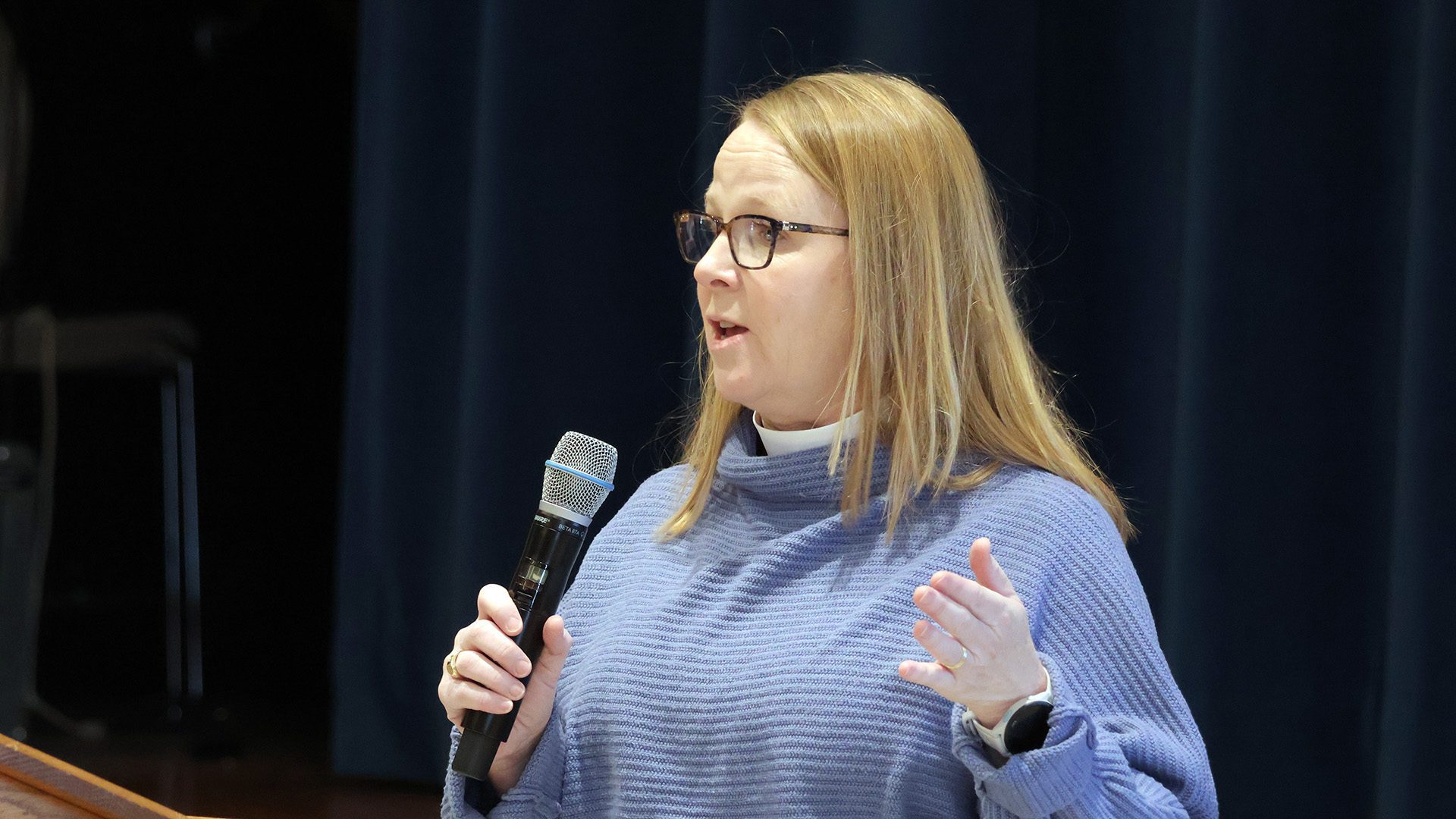

Students and faculty from the School of Theology listening to Bishop Amy’s presentation. Photo provided by the School of Theology Facebook page.
Ministry is at the heart of what clergy and lay leaders do across the world. From pastorally caring for our neighbors to tending our communities, the work can be fulfilling and impactful.
It can also be demanding.
For many of us, ministry can sometimes feel endless, with no real results on the horizon. This can happen when we feel discouraged by a lack of motivation or when our hard work has little to no payoff. So how do we continue God’s work while also nourishing our mind, body, and spirit? That question was at the heart of Bishop Amy’s presentation at The School of Theology at The University of the South in Sewanee, Tennessee. Titled Numbing, Nourishing, and Unwinding: Practices for Real Life, the presentation focused on burnout prevention and the practices that help make our ministry more sustainable.
The School of Theology begins each academic year with a quiet retreat day where students and faculty can make time for reflection and prayer. Walker Adams, Acting Associate Dean for Admission & Advancement at the School of Theology, said the school intentionally invites “important and diverse voices from the House of Bishops” to help guide the community’s thinking at the beginning of each year.
“She encouraged the community to do some self-reflection on healthy and unhealthy practices and encouraged us all to slow down and develop a deeper appreciation for process itself,” Adams said.
The workshop was more than avoiding burnout; it was also about recognizing how God meets us in the daily practices of our lives and how we can make room for rest and renewal in the process. Justin Smith, a postulant from The Diocese of West Missouri at Sewanee, said Bishop Amy’s presentation stood out because she spoke about the realities of ministry.
“Bishop Amy’s presentation on burnout prevention and best practices for sustainable ministry was thoughtful, useful, and engaging,” Smith said. “We often talk about ‘numbing’ in less than positive ways when discussing individual self-care,” Smith said. “Bishop Amy’s insights and perspective helped reframe these popular opinions in a deeply spiritual way, giving clergy and leaders permission to numb themselves as a nourishing, spiritual practice. In the business of ministry, we are taught self-sacrifice in our call to serve God, but if we deplete ourselves of the very things we need to enrich and sustain our mind, body, and spirit, we limit the spiritual growth in our own relationship with God, let alone have the ability to offer anything deeply spiritual to the people around us.”
Timothy Sallee, another postulant from The Diocese of West Missouri at Sewanee, said that one of the more memorable moments from Bishop Amy’s presentation was the image of “making camp.”
“There is a section in Bishop Amy’s presentation where she talks about ‘Making Camp’; this beautiful idea of taking the time in the midst of life to set up tent and rest,” Sallee said. “Yes, we are called upon to sacrifice and pour out our hearts and love for others, but if we never take time to refuel, we can only go so far.”
Taking time away from the work doesn’t mean taking time away from ministry. In fact, Bishop Amy believes the opposite to be true.
“For me, the heart of ministry is relationship with God and my community,” says Bishop Amy. “Practicing the presence of God enriches, inspires, and empowers my relationship with my community. As I receive the compassion, grace, and love of Jesus in my life, I grow my capacity for these in every other relationship.”
By the end of the presentation, seminarians and faculty were invited to not only consider what they need to do to renew themselves but also to consider what it means to minister in a way that can be sustained.
“I hope that the people of Sewanee felt empowered and inspired to practice the presence of God in their lives, and that they aware of God’s presence at all times and in all places. God is with us in our love and grief, anger and joy; God is with us as we play and work. The more we practice God’s presence our confidence and dependence on God will grow, empowering us as faithful ministers of the Gospel.”
Self-care is not about stepping away from the call to serve. It can be part of how we sustain that call. Because what we sometimes forget is that rest, renewal, and nourishment aren’t a departure from the work of our ministry.
It’s part of how God prepares us to continue.
You can download a full copy of Bishop Amy’s presentation below.


